Seedling vs weed: how to tell them apart in overhead imagery
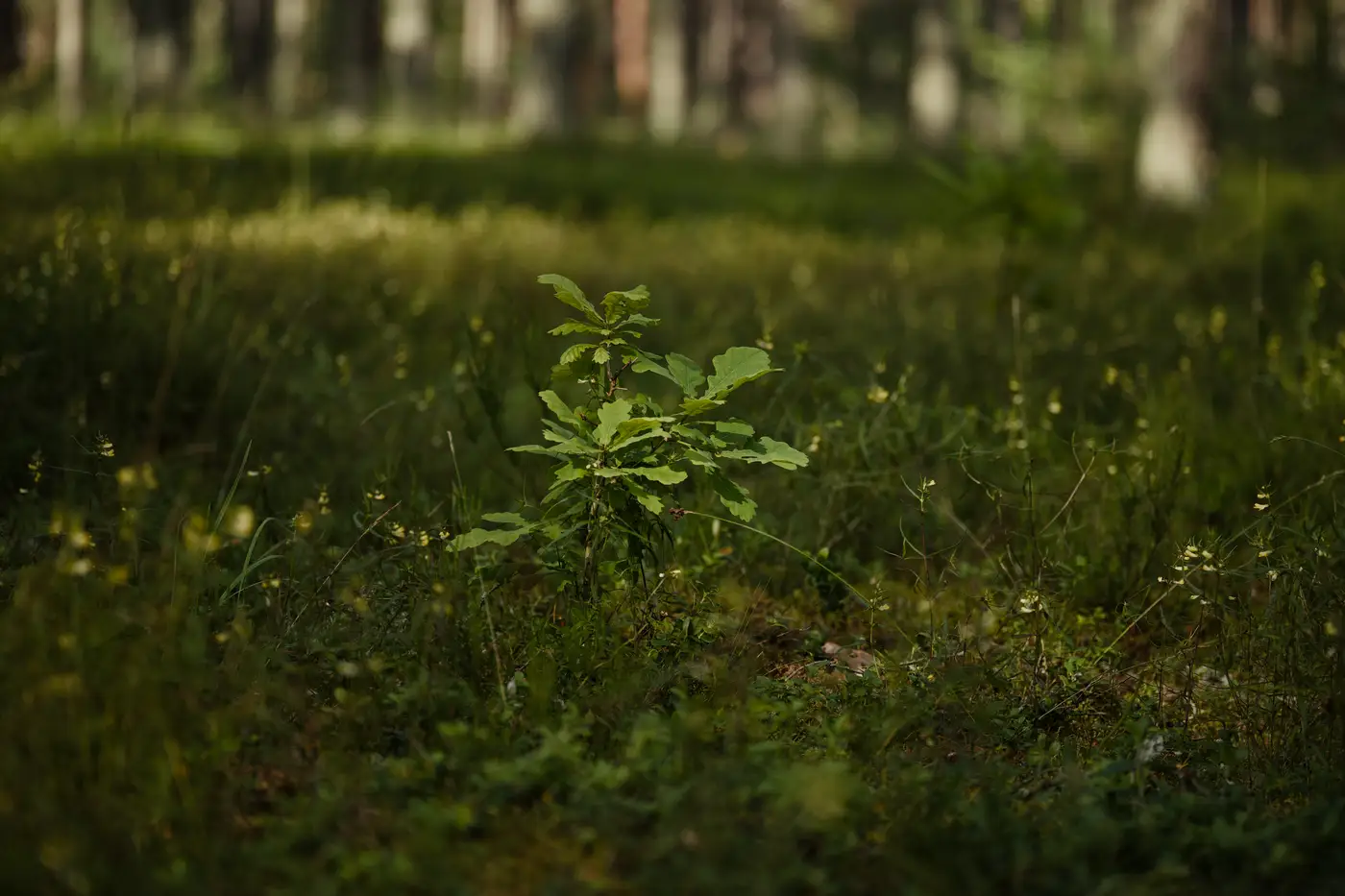
A stocking count off a flight runs into the same problem every ground crew runs into on the first lap: a green blob at 8cm per pixel doesn't announce what it is. A planted Doug-fir plug, a blackberry cane filling the gap where a plug died, an alder sprout that seeded in off the adjacent stand. From straight overhead, early in the season, they can all read as the same shade of green.
On a replanted block, that's not a cosmetic problem. It's the difference between a stocking report that matches the contract and one that gets kicked back.
The grid tells you more than the leaf does
Position is the single best cue in an overhead image, more reliable than color or leaf shape. Planted seedlings sit on planting spots, and planting spots follow a pattern: a spacing prescription, a row offset, sometimes hand-planted but still laid out to a target density per hectare. Volunteer vegetation doesn't know the prescription. It shows up where a seed source and open ground happen to meet, which means it clusters along draws, old skid trails, unit edges next to standing timber, or wherever the slash pile burned hot enough to open mineral soil.
So the first question in telling a seedling from a weed isn't "what does this look like" but "where is it sitting relative to the plan." Something centered on a planting spot, roughly on-grid with its neighbors, is almost certainly the seedling. Something offset, clustered, or running in a line that doesn't match row spacing is almost certainly not.
That one check catches most of the obvious cases. It doesn't catch the ones sitting close to a spot by chance, and it won't tell you a planted seedling died and something else took root right next to the stake. For those, you need a second pass.
Leaf-out timing and crown shape do the rest
Planted species and volunteer species usually green up on different schedules. A conifer plug holds its needles through winter and doesn't change much flight to flight. A hardwood sprout or a herbaceous weed can go from bare ground to full leaf in a few weeks and then die back or get mowed down by frost. Comparing two flights a season apart, not just one, separates a lot of what a single pass can't: anything that wasn't there last flight and is gone again by the next one almost certainly wasn't the seedling.
Crown shape matters too, once you're looking at something that survived more than one season. A young conifer reads as a tight, roughly conical crown. A hardwood volunteer, blackberry mat, or Scotch broom clump reads as an irregular blob with ragged edges, and it often outgrows the planted stock fast enough that size alone becomes a flag. A three-year-old seedling at a given spacing has a rough expected crown diameter. Something twice that size on the same spot three years in usually isn't what got planted there.
Why the misclassification matters more than it sounds like it should
Get this wrong in either direction and the stocking number is wrong. Count every green thing on a spot as a surviving seedling and you underreport the gaps, which means the beat-up planting that should have gone in this season doesn't, and the block shows up short again next year with a harder case to make. Flag genuine seedlings as weeds because they're small, stunted, or half-buried in salal, and you walk crews off spots that need a release treatment instead of infill, or you double-plant a spot that was never actually empty.
A walked sample plot avoids most of this because a tech on the ground knows a plug from a weed at a glance, no imagery required. The tradeoff is that a sample plot covers a fraction of the block and gets extrapolated to the rest. A full count from the air can cover every planting spot on the unit, but only if it's checking those spots the same way a tech would: against where the seedling was supposed to be, not just what's green that week.
Reforestation Monitor checks both of those at once on each planting spot: where it sits against the layout, and what the vegetation signal there is doing flight to flight. If a block's stocking report is due and you'd rather not find out the hard way which greens were weeds, see what that looks like on a pilot block.